I finished the last prestige release of the season around midnight, took my usual walk along the lakefront in Madison, and realized I could not remember a single specific thing about the thirty hours I had just spent. That silence is the subject of this piece. On this AAA game review blog I have spent a decade separating craftsmanship from genuine artistic force, and the gap between those two things has never been wider than it is in the current cycle of big-budget releases. These games arrive with orchestral scores, photoreal faces, and nine-figure budgets, and they still feel like they were assembled by a committee that was afraid to answer the question: what is this actually about?
The Prestige Problem: Money Replaces Conviction
The conclusion is blunt: modern AAA prestige games buy competence and lose their voice in the transaction. Capital flows toward surfaces — terrain density, performance capture, lighting pipelines — because surfaces are predictable, schedulable, and safe to show shareholders. Conviction is none of those things. Conviction requires a creative lead who can cut a beloved feature, kill a safe subplot, or ship an ending that leaves a room quiet, and that kind of authority is exactly what large-scale production pipelines erode first.
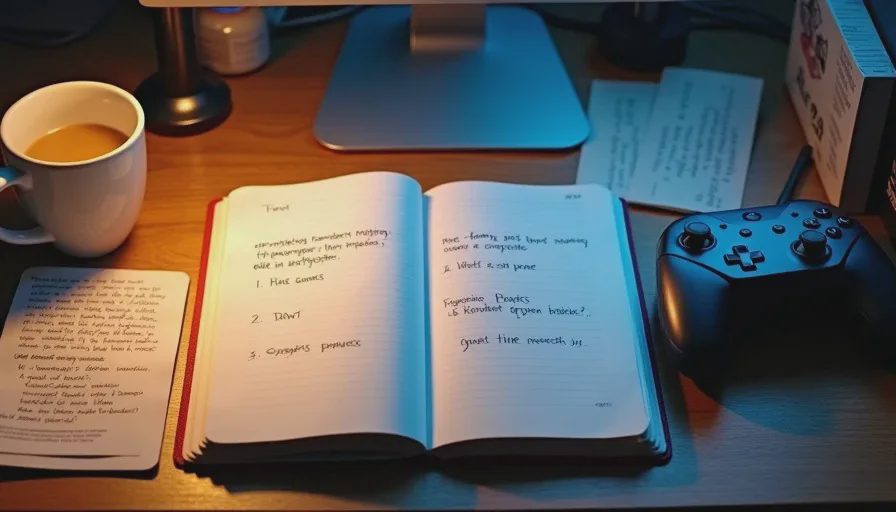
I keep a notebook on my desk with four questions I ask before writing any review: What does this game want? What does it refuse? What does it waste? What remains? Applied to the recent wave of prestige titles, the answers collapse into the same flat note. They want to be admired. They refuse to risk anything. They waste their budgets on scale. What remains is a technically accomplished product with no pulse.
What the Budget Actually Buys
Here is what I tracked across my playthroughs while preparing this AAA game review blog entry on the season's biggest releases:
Where the Money Goes | What the Player Receives |
|---|---|
Performance capture and celebrity voice casts | Long cutscenes the player watches instead of plays |
Terrain, foliage, and weather systems | Repeated bandit camps and fast-travel checkpoints |
Marketing blitz and global reveal events | Pre-order pressure and fear of missing out |
Live-service backend and seasonal roadmaps | A game that ships half-finished and apologizes later |
The pattern is consistent: money flows toward things that photograph well in a trailer. Imagination — the kind that asks whether a mechanic means something — gets trimmed during milestone reviews because it cannot be quantified in a quarterly investor call.

Why Caution Wins the Argument
I sat in enough editorial planning rooms during my years on the reviews desk to understand the logic. A studio investing two hundred million dollars cannot afford a creative choice that alienates the opening-weekend audience. Shareholders demand predictability, and predictability produces a product that resembles last year's product with better lighting. When I run an indie vs AAA game review comparison, this is the fork in the road: small teams risk because they must, and large studios hedge because they can. The result is a generation of releases that are professionally assembled rather than creatively alive, and readers who follow this AAA game review blog know that distinction is the one I care about most.
The Indie Counterweight: Conviction on a Shoestring
Independent games routinely deliver what nine-figure prestige titles cannot: a coherent artistic statement. They lack the resources for photorealistic forests, but they understand that a game is not a technology demonstration — it is a set of rules designed to make the player feel something specific. When I write an indie vs AAA game review piece, the indie side almost always wins the What remains? question, even when it loses every technical category on paper.
What Small Teams Do Differently
Across a decade of editing game criticism, I have noticed the small-studio games people remember share traits that big-budget teams routinely sacrifice:
A clear thesis — you can summarize the game's argument in one sentence, because someone designed it around an idea rather than a feature checklist
Mechanical honesty — every system reinforces the central feeling; nothing exists simply because a competitor had it
Respect for the player's time — shorter runtimes and tighter pacing instead of filler designed to justify a season pass
A voice — not tone assembled from focus groups, but a perspective attributable to a specific person
These are not virtues exclusive to indies. A handful of large studios still hold the line. But the pattern is hard to ignore: the less a team has to hedge, the more likely the game has a pulse.
The Honest Caveat
Let me be clear, because fairness matters more than provocation. Many independent games are thin, derivative, or unfinished. Budget does not ensure quality, and its absence does not either. I have played ambitious indies that collapsed under their own scope and polished blockbusters that earned every dollar they spent. My complaint is not with money — it is with money used to substitute for a point of view. A well-funded game can still have a voice; it just rarely chooses to. That is the observation I return to every time I sit down to write another AAA game review blog post: the problem is not resources but intent.
What Remains: A Framework for Readers
Here is the practical takeaway if you read this AAA game review blog trying to decide where your limited hours should go. Not every good game is worth your time. A technically competent release with nothing to say will consume your weekends and leave you with nothing to discuss afterward. The prestige machine is skilled at making you feel you should care — the launch trailers, the embargoes, the discourse that arrives pre-packaged. The question is whether the game earned that feeling or merely purchased it.
I apply my four questions to every release, and they cut through prestige noise better than any score:
What does this game want? If the answer is "to be admired," proceed with caution.
What does it refuse? A game that refuses nothing usually stands for nothing.
What does it waste? If a hundred-million-dollar budget yields no memorable moment, the waste is the budget.
What remains? After the credits and the discourse, if the lighting engine is the thing you remember, the game did not do its work.
I have used these prompts across budget tiers in indie vs AAA game review pieces alike, and they hold up at every scale. A two-person studio can fail the fourth question just as a three-hundred-person studio can pass it. The scale of ambition is what matters, not the scale of the invoice.





No feedback yet — submit the first.