
Every June, the industry floods my inbox, my feed, and my podcast queue with trailers, hands-on impressions, and dev diaries. By mid-August, most of that noise has gone quiet, and only a handful of games that stay with you remain lodged in my thinking. Not the ones with the loudest marketing campaigns, but the ones that survive the three-week cool-down after showcase season ends and still ask to be played. I'm Nolan Pierce—I spent a decade editing game reviews at a regional outlet and then a national one, and now I write this column and a weekly newsletter from a desk in Madison, Wisconsin, surrounded by old strategy guides I can't bring myself to throw away. This is a column about the games that stay with you long after the hype cycle has moved on to whatever comes next.
What Survives the Hype Cycle
The games worth your attention after a showcase are rarely the ones that dominated the recap livestreams. They are the ones whose core mechanic or narrative hook keeps generating questions after the demo fades, the ones that quietly qualify as games that stay with you through their design rather than their marketing.
The Three-Week Filter
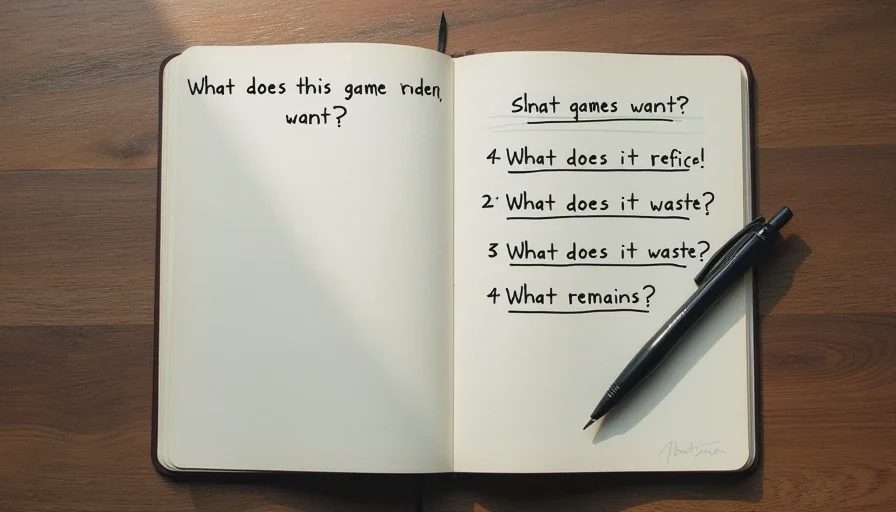
I use a simple test. After a showcase ends, I write down every game that caught my eye in a notebook I keep next to my desk. Then I wait three weeks. Whatever I still want to look up—without prompting from a press release or a creator code—is what makes the shortlist. This year, four games passed that filter, and only two of them appeared in any major recap I watched.
Game | What Hooked Me | Still Thinking About? |
|---|---|---|
A small narrative adventure | The silence between dialogue lines | Yes—the pacing stayed with me |
A tactics roguelike | One map that inverted my assumptions | Yes—I want to understand the design |
A cozy farming sim with a twist | A single tonal shift in the demo | Uncertain—could be a gimmick |
A sci-fi exploration game | The sound design during a walking section | Yes—I keep replaying that moment mentally |
The farming sim is the one I'm most cautious about. A tonal shift in a curated demo can mean the full game commits to that shift across forty hours, or it can mean the demo front-loaded its one interesting idea. I won't know until I play it, and I won't play it until reviews from critics I trust are published.
One thing I've learned from editing other people's reviews for ten years: the games that stay with you almost always have one moment that doesn't look like anything in the trailer. The trailer shows you what the game wants to be seen as. The moment that sticks is what the game actually is. That distinction matters more than any preview build.
The Difference Between Craftsmanship and Force
There's a distinction I keep returning to in my reviews: a game can be beautifully made and still leave no residue. Craftsmanship is the floor—expected, respected, but not sufficient on its own. What I'm looking for is genuine artistic force, the sense that someone made a specific, irreversible choice about what this game should be and what it should refuse to be.
Why Some Well-Made Games Don't Stick
I've played dozens of games with tight controls, clean UI, and competent art direction that I forgot within a week. The issue isn't quality. The issue is that nothing in the design took a risk the player could feel. These are the questions I ask before deciding which are the worth playing new games that earn my limited evening hours:
Does the game want something from me beyond consumption?
Does it refuse something that most games in its genre would readily allow?
Does it waste any of its own systems—a mechanic that never justifies its presence?
What remains after I stop playing? A feeling, a question, an image?
These four questions come from the same notebook I mentioned earlier. They're not a scoring rubric. They're a way of noticing whether a game is doing something I haven't seen before, or whether it's executing something I have seen before, just with more polish and a bigger budget. The games that stay with you answer all four. The ones you forget answer none.
Not every good game is worth your time. A game can be competent, even impressive, and still not need to exist in your library. That's not an insult to the developers who built it. It's a statement about the finite hours of the person holding the controller. I'd rather spend fifteen hours with a rough-edged game that made one brave choice than forty hours with a smooth one that made none.
How to Build Your Own Post-Showcase Shortlist
The practical version of what I do isn't complicated, but it requires resisting the urgency that showcase season manufactures intentionally. The entire format is designed to make you feel that you are missing something if you don't act now. You aren't. The games that stay with you will still be there in three weeks, and if they aren't, they were never going to be worth playing new games in the first place.
The Cool-Down Method
During the showcase: Note every game that interests you. Don't curate, don't rank, just record. My list this June had twenty-three games on it.
Week one after: Avoid all coverage of those games. No trailers, no previews, no hands-on reports. Let the initial impression breathe without reinforcement.
Week two: Revisit your list without looking anything up. Cross off anything you can't remember clearly. The ones you can still describe from memory are your candidates. My twenty-three became five.
Week three: Look up only the candidates. Read reviews from individual critics whose taste you understand—not aggregator scores, but people whose perspective you've learned to calibrate against your own. Watch one piece of extended, uncut gameplay. Then decide.
Two pitfalls I see every year, and that I fell into myself when I was still editing at a national outlet:
The first is pre-ordering during showcase season based on a six-minute demo. Demos are curated experiences. They show you the game at its most controlled and intentional. A demo that feels great in June may come from a build that doesn't represent the full game's pacing, difficulty curve, or content depth. The three-week filter exists precisely to buffer against that manufactured enthusiasm.
The second is treating review embargo timing as a signal of quality. Early embargoes don't mean confidence. Late embargoes don't mean trouble. Embargo timing is a PR strategy, not a quality indicator. I've seen games with day-before-release embargoes turn out to be thoughtful and rewarding, and games with week-early embargoes turn out to be hollow once the marketing shine wore off and players reached the actual midpoint.
The games that stay with you reveal themselves slowly, often after the conversation has moved on. That's the point. If a game needs the hype cycle to matter to you in June, it probably won't matter to you in November.



No feedback yet — submit the first.