The game loop is the quiet machinery beneath nearly every interactive experience. It is what you do, what the game gives back, and why you decide to do it again. In a shooter, that might mean entering a room, reading threats, firing, collecting resources, and choosing the next route. In a farming game, it could be planting, waiting, harvesting, selling, and expanding. The actions are simple. Their arrangement is where a game begins to reveal its character.
For players with jobs, obligations, and a backlog that has become faintly accusatory, understanding the game loop is more useful than another list of features. A large map does not guarantee discovery. A hundred-hour campaign does not guarantee depth. What matters is whether the repeated action develops into rhythm, thought, tension, or feeling. Not every good game is worth your time.
What the game loop actually contains
At its most basic, the game loop has three parts: an action, a response, and a reason to continue. You make a decision, the system produces a result, and the result changes what you can do next. The quality of the game loop depends on how clearly those parts connect.
Consider a stealth game. You study patrols, move through cover, create a distraction, and reach a new position. If the guards react in understandable ways, your failure teaches you something. If the game opens a new tool after several successful infiltrations, that tool changes the next problem rather than merely decorating your inventory. The repetition gains shape.
A weak game loop often hides behind constant rewards. New weapons, currencies, badges, and upgrade screens can create activity without creating meaning. If every encounter feels like a minor variation on the last, the player eventually notices that progress is cosmetic. The game is moving, but the player is not thinking differently.

The strongest loops make the player more perceptive. Early in a game, a room may look like a collection of obstacles. Ten hours later, the same kind of room becomes a sentence with punctuation: a loud entrance, a risky flank, a resource to preserve, and a decision about whether speed is worth exposure.
Repetition is not the enemy
Critics sometimes describe repetition as a flaw in itself. That is too blunt. Repetition is the foundation of music, sport, cooking, and language. The question is whether each return reveals a new relationship between the player and the system.
The combat in a game such as Hades works because repeated attempts are not identical. The rooms, weapons, upgrades, and enemy combinations alter the meaning of familiar actions. Failure is not simply a reset. It is a conversation between the player’s habits and the game’s demands. The game loop asks the same broad question while changing the terms of the answer.
By contrast, a loop can become exhausting when the player’s understanding stops developing. A character may gain larger numbers, but the player still presses the same safe attack against the same predictable threat. This is progression as accounting. The total rises; the experience stays still.
Good repetition also has a rhythm. A tense sequence needs a quiet stretch afterward. A difficult decision benefits from a moment in which its consequences can be understood. Games that place reward screens, errands, combat, and story beats at the same volume can make even excellent elements feel like noise.
Friction, convenience, and the cost of continuing
The game loop is also a measure of friction. Some friction is productive. Reloading in a tense shooter, carrying limited tools in a survival game, or navigating a dangerous route can make choices matter. The player feels the shape of a problem because the solution is not free.
Unproductive friction is different. Menus that bury essential information, long animations that cannot be skipped, repeated tutorials, and slow travel between identical tasks consume attention without deepening the game. These details are not always disastrous, but they tax the player’s patience. Over several evenings, small delays become the experience.
This is where design meets the reader’s real life. A game loop that felt charming on a Saturday afternoon can feel punishing after work, when a thirty-minute session contains ten minutes of inventory sorting and unskippable dialogue. Convenience is not the opposite of seriousness. Sometimes removing a chore allows the important decision to stand out.
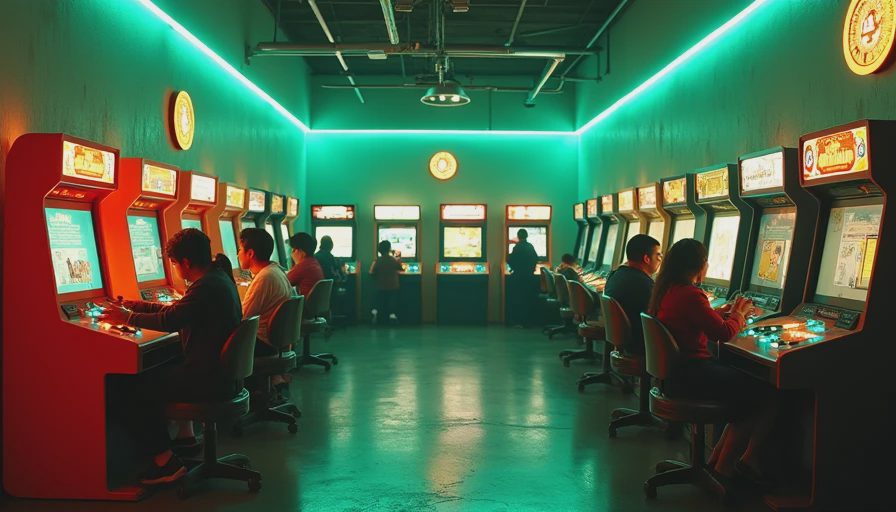
The best games know what their friction is trying to express. A scarce resource can create dread. A slow walk can establish grief or place. A cumbersome machine can communicate vulnerability. But when inconvenience has no artistic or mechanical purpose, it is merely unpaid labor demanded from the player.
When a loop becomes a point of view
A game loop becomes memorable when its repeated actions say something beyond themselves. In Papers, Please, checking documents and enforcing rules gradually turns administrative procedure into moral pressure. The loop is not just paperwork. It is a way of making the player feel how systems reduce human lives to decisions made under time and scarcity.
Likewise, a management game can express care through maintenance. Assigning workers, balancing supplies, and repairing equipment may look abstract, but the loop can produce a genuine attachment to fragile routines. The player learns that survival is not a dramatic victory. It is a sequence of modest decisions made before the next crisis.
This does not mean every game needs a political thesis or a solemn theme. A bright arcade game can have a precise point of view. It may value speed over caution, improvisation over planning, or mastery over spectacle. The important thing is alignment. The game loop should support what the game appears to believe.
When a game claims to be about exploration but fills every corner with identical errands, the contradiction is felt mechanically before it is articulated. When a game presents choice but funnels every decision toward the same outcome, its promise weakens. Players are sensitive to these gaps because they inhabit systems rather than merely observing them.
How to judge a game loop before committing
The practical test is not whether the first hour feels entertaining. Most polished games can manage that. Ask what changes after five hours. Are you seeing more clearly, deciding faster, taking greater risks, or interpreting familiar situations in a new way? If the answer is no, the loop may be relying on novelty that will not survive the opening weekend.
Watch for the ratio between meaningful decisions and maintenance. How often are you choosing a route, tool, target, or sacrifice? How often are you moving icons between menus, repeating a solved task, or waiting for a progress bar? A game can include chores, but it should understand the difference between a ritual that builds atmosphere and a task that simply delays the next interesting moment.
Also notice what the game remembers. Some systems record your choices and let them alter future conditions. Others only record currency and experience. Neither approach is automatically superior, but memory gives repetition consequence. Without it, the loop can feel like a treadmill with better lighting.
Finally, ask whether the game earns its length. A focused twelve-hour experience may leave a stronger impression than a sprawling campaign that repeats its central idea until affection turns into obligation. Not every good game is worth your time, and duration is not evidence of ambition.
What remains after the loop ends
The game loop is where design becomes personal. You can admire a combat system and still find its campaign exhausting. You can dislike a genre’s surface conventions and still recognize an unusually honest structure. The point is not to reduce every game to a formula. It is to notice what the formula is doing to your attention.
A successful loop gives repetition a memory. It teaches your hands, then challenges your judgment. It creates habits, interrupts them, and makes the interruption matter. At its best, the loop does not feel like a treadmill at all. It feels like a rhythm you have entered willingly, one that clarifies the game’s world and your place inside it.
That is the standard worth carrying into your next purchase. Look past the map size, feature count, and carefully staged trailer. Find the recurring action. Ask what it rewards, what it wastes, and what it gradually teaches you to feel. If the answer has conviction, the game may deserve a place in your limited evenings. If it does not, walk away without apology.




No feedback yet — submit the first.