The most common error I see in game pacing analysis is waiting for a game to get boring before asking why it will get boring. After more than a decade in games media — first as a staff editor, then as reviews editor — and now as an independent critic writing long form video game reviews from Madison, Wisconsin, I've learned that the sagging middle almost never starts in the middle. It starts in the first hour, sometimes in the first menu screen. The midpoint collapse you complain about at hour twenty-five is the same problem you shrugged off at minute forty. I don't say this to make anyone feel foolish. I say it because recognizing the early warning signs turns pacing from a mystery you suffer through into a skill you can train.
The Opening Hours Are a Contract
The first two hours of a game are a contract, not a prologue. In my years on staff, the reviews that predicted a collapse with eerie accuracy were the ones where the writer trusted the opening as evidence. When the contract promises discovery but delivers a slow drip of systems with nothing to discover, the game runs out of new things to say long before the credits. Pacing is not "when things happen." Pacing is when the player feels their own growing competence — and that feeling is either manufactured in the opening hours or it never arrives.
Pacing Is Promised Before It Is Performed
We used to call it "tutorial hangover" in the newsroom. The game opens with a glorious power fantasy — a sword that cleaves the world, a ship that jumps across galaxies — then quietly takes it away and drops you on an empty map. That is not a hook. That is a contract signed in one font and delivered in another. When the promise is an event rather than a curve, you can predict the hour-thirty collapse by minute ninety. The structure has already told you what the content will have to work against for the rest of the run.
Here is the short checklist I run through in the first session, and it has held up every time I compare it against what shows up later:
Warning sign in the opening | What it usually predicts |
|---|---|
A second tutorial for the same system | The game distrusts its own design |
Tutorial segments longer than the play between them | Cutscene pacing will dominate the middle |
Side content and main quests pay the same rewards | The game has no economy of attention |
A long opening cutscene followed by a wide-open map | The world is content, not structure |
None of these are fatal on their own. Together, they are the outline of a pacing problem that will announce itself at the midpoint as if it were new.
The Tutorial Is a Trailer
A good tutorial is a trailer that happens to be playable. It shows you the fullest version of the game's rhythm, then spends the next few hours building toward it. The industry data points the same direction: player-drop research and Steam playtime distributions consistently show a steep abandonment spike inside the first two hours, long before most reviewers file a first impression. If the opening does not manufacture competence fast, no amount of later content rescues it. As a reviewer, that means the opening hours are not a warm-up you can skim. They are the specimen.
When the Structure Bends Your Back
Structure problems are worse than content problems, because a dull quest can be skipped but a broken rhythm makes every quest exhausting. In long form video game reviews, I spend less time asking whether a quest is good and more time asking where it sits in the game's economy of attention. A game that hands you a giant map before it gives you a reason to want distance is not open world; it is open desert.
The Side-Quest Economy
The side quest is the clearest place to watch a contract break. In the opening, a side quest is a reward for curiosity. By hour fifteen, it is a tax. The difference is whether the game respects your attention the same way it respects your time — whether optional content pays in story, in friction, or in busywork. When a game starts paying side quests in currency that no longer matters, it has stopped asking what the player wants. That is not a content problem. It is a structural decision made before the midpoint, usually visible in the very first side quest.
Length Without Density
Length and density are not the same thing, and I have made the mistake of treating them as interchangeable. A forty-hour game built on ninety-minute loops is not longer; it is stretched. The test is simple: does the player accumulate understanding, or just items? When you can see the pattern of a level before you finish it, the design has run out of structure and is running on schedule. That is the point where I write in the margins: "the design has stopped deciding."
How to spot the padding early, before you commit fifty hours:
Every environment is introduced with the same two-step loop of gate, then key.
Dialogue recap systems appear because the game expects you to forget.
The difficulty curve is a flat line dressed as an incline.
Fast travel exists, and you still spend a third of your sessions crossing the same ground.
If four out of four sound familiar, the midpoint collapse is already scheduled. You just have not reached it yet.

Reading the Curve Before You Commit
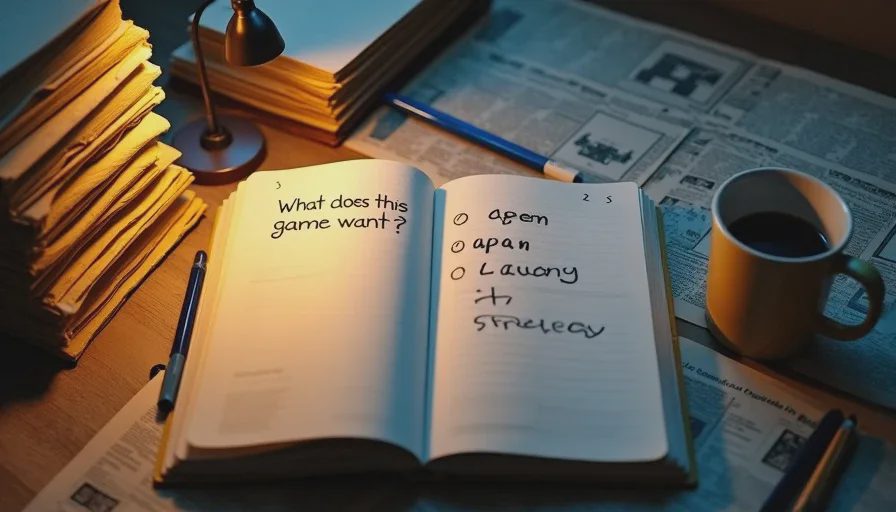
The practical payoff of thinking this way is time saved — my own time as well as yours. This is where game pacing analysis stops being academic and starts doing useful work. Before I start any review copy, I log the first hour with timestamps the way a field reporter logs a scene, because memory flatters and timestamps do not. Then I run the game through four prompts I keep taped to my notebook, the same ones I used as an editor to decide whether a pitch deserved a second draft. They are not about taste. They are about the game's internal honesty.
The Four Questions
What does this game want? If I cannot answer in one sentence, the design cannot either.
What does it refuse? Refusals are where identity lives; a game that refuses nothing has no spine.
What does it waste? Every game wastes something — the question is whether the waste is incidental or structural.
What remains? After the systems, the set dressing, and the marketing, what do you carry out of the session?
A game that answers all four cleanly can still bore you, but it will not lie to you. And in my experience writing long-form reviews, a game that lies to you in the first hour is the most predictable story I know how to tell.
The Midpoint Collapse Is an Opening Problem
When a review reaches the midpoint and the energy drains, readers assume the game betrayed its early promise. Usually it did not. The opening made a promise it could not keep, and the midpoint is just the day the debt came due. That reframing matters because it moves the conversation from "this game got bad" to "this game was never designed to hold a line." The fix is not in the game; it is in how you read the first hour. Play the opening like a detective, not a tourist.
Not every good game is worth your time. That was the note I kept sending back to writers as an editor, and it is still the thesis of everything I publish now. Pacing is the mechanism that tells you which side of that sentence a game falls on — and the mechanism is visible long before the midpoint. You just have to be looking at the right hour.





No feedback yet — submit the first.