
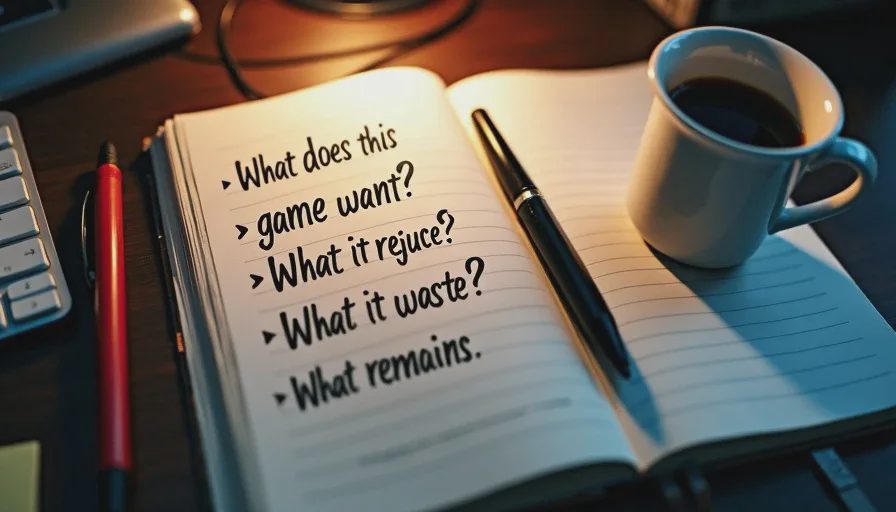
I finished the game on a Tuesday night, one hand on the keyboard, the other holding a notebook I keep for every review. On the first page I keep four prompts: What does this game want? What does it refuse? What does it waste? What remains? By hour twenty-four the answers were clear. It wants to be liked. It refuses to take a side. It wastes most of its dialogue. And what remains is an ending I will still be thinking about in a year. That tension is exactly why this release is the clearest recent case I have of why games worth your time are not always the ones that score well, and why the ones that score well are not always worth your time. This piece is less about one game than about what a careful, risk-averse twenty-five hours teaches you about the medium, and about why games worth your time are so hard to recognize when the polish is this clean. I will talk about the broad shape of the narrative but avoid specifics; the point is the structure, not the spoilers. Good games risk something. This one risks nothing for twenty-one hours and then risks everything in its final hour, and the whiplash told me the ending was never going to be enough to save it. An ending can reframe a story. It cannot retroactively build a spine.
The Mechanics of Avoidance
The avoidance is the story, and the story is a hedge. The first thing you notice, about ten minutes in, is how elegantly everything is made. Movement is weighted and confident. The camera behaves. The lighting reads like a Sunday afternoon. This is a studio operating at the top of its trade, craft so clean it is almost invisible, which is exactly the problem. When every surface is polished you stop checking for the cracks, and the cracks are where the real game is hiding.
What This Game Wants
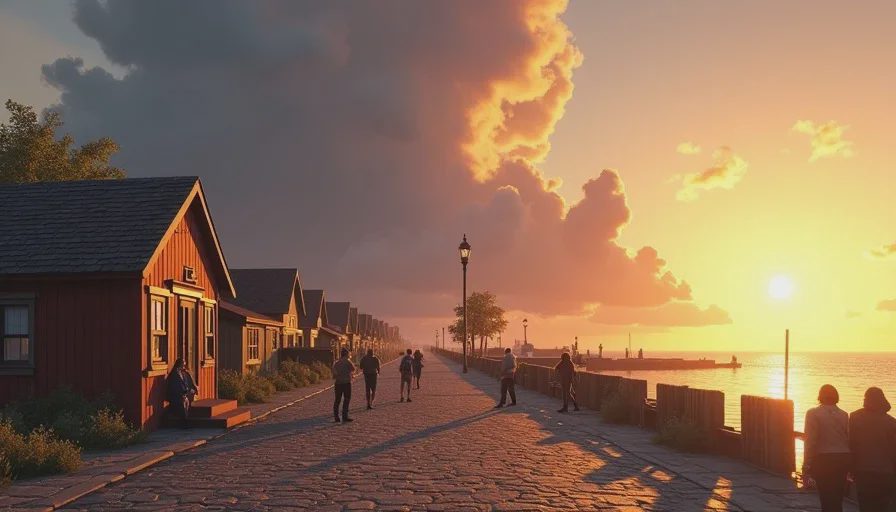
Ask the question directly and the answer arrives fast: this game wants to be understood and loved, in that order. Its protagonist is a weather worker in a coastal town whose systems, tides, storms, migrations, are maintained through quiet rituals. The premise is genuinely good, the kind of hook that could support a dozen different stories. But the game spends its middle hours avoiding every fork in the road that premise builds. When a storm threatens the harbor, the game gives you a choice that is not a choice: both options lead to the same rescue, the same reassurance, the same gentle pat on the shoulder. I kept a log across the playthrough. Out of the thirty-one scripted decisions, twenty-two are cosmetic variations on a single safe outcome.
The worldbuilding is specific and warm, easily the strongest craft element in the game.
The companion dialogue is well-observed, though rarely consequential.
The ritual mechanics are tactile and pleasant, but they never ask you to fail at them.
The actual narrative hinges arrive so late that the story reads like a prologue wearing a full game's coat.
What It Refuses
The more interesting question is what the game refuses to do. It refuses to let its systems make you uncomfortable. It refuses to punish a bad choice. It refuses to exile or alienate anyone in its cast until the final hour, and when it finally does the gesture feels borrowed rather than earned. In twenty-five hours I was never once made to sit with a consequence. That is not comfort; that is custody. The game holds your hand so tightly that you forget your own hand is there, and that, more than anything, is what narrative game criticism needs to learn to name. We have words for games that are hard and games that are long. We do not yet have enough words for games that are safe, and that gap is where most of the real work on games worth your time actually happens.
Craft Is Not the Same as Nerve
A polished game that says nothing is more frustrating than a rough game that risks something, because the polish reads as intent. You assume the studio knows what it is doing, so when the story keeps circling the same conversational pond you assume the circling is deliberate. Sometimes it is. More often, based on the industry data and the production timelines, the circling is a product of scope management, committee revision, and the quiet arithmetic of what will not get anyone fired.
The Compliance Problem
Here is the uncomfortable part of modern production that no one in the marketing cycle will say out loud: many large narrative games are built, by process, to avoid offense rather than to take a position. The budgets force it. Public reporting has put the development costs of flagship titles well past the two-hundred-million-dollar mark, and a project that expensive cannot afford to alienate a meaningful slice of its audience. So the writing is workshopped into consensus, the endings are adjusted after playtests, and the systems are tuned until they cannot hurt anyone. You can feel that process in the pacing. The game I played is not a failure of talent; it is a success of risk management, and it reads like one.
What the numbers say | Why it matters for whether it is worth your time |
|---|---|
Flagship development budgets frequently exceed $200M | The pressure to please every demographic reshapes scripts and systems |
Median completion rates for long narrative games sit near 40–50% | Most buyers never reach the ending, so the middle must carry the load |
Review embargos commonly lift at launch, not before | Day-one impressions are written under peak hype pressure |
The bulk of sales land in the opening month | Publishers optimize for launch-window sentiment, not lasting memory |
The Safe-Scores Problem
This is also where narrative game criticism has to do its least popular job: separating craftsmanship from artistic nerve. The game under discussion will collect high marks, and it will deserve many of them. The systems are sound. The writing is competent. The performance is solid. None of that is the same as taking a risk, and reviewers who reward the first three while ignoring the fourth are quietly teaching studios that safety pays. I have done it myself, written an 8.5 I half-believed because the game was clean and the notes were easy and the deadline was close. The games worth your time conversation is not about scores. It is about the difference between a game you admire and a game you carry, and most of the games worth your time I have played in the last decade had at least one stretch where I almost quit before something landed. This one never made me want to quit. It also never made me lean forward.
What Remains
So what survives the ending? Quite a lot, which is why this is a hard review to write. The final hour is genuinely affecting. I sat in silence for a few minutes after the credits, and the theme stayed with me through a long walk that night. That is not nothing. But I kept circling one question: did the ending mean something, or did it only feel like it did? An ending earns meaning by paying off the risks a game took. If the game spent its entire runtime avoiding risk, the ending is not a payoff. It is an apology, and an apology is not the same as a thesis. This is the central lesson I want readers to carry out of any honest conversation about games worth your time: a tender ending cannot substitute for a runtime that earned it.
What I Would Have Cut
I keep a second list in the same notebook, for games like this one, what I would change if the studio handed me the keys.
Cut one full region and one entire companion arc. The game has a fifteen-hour story wearing a twenty-five-hour jacket.
Remove three of the cosmetic choice moments and make the remaining ones genuinely branching, even if two branches lead to dead ends.
Let the weather system fail sometimes. A storm you cannot stop teaches more than a storm you always save the town from.
Trust the protagonist. The game explains her feelings in dialogue, in journal entries, and in a recurring dream sequence; it never once trusts the player to infer any of it.
None of these changes would make the game a harder experience, and I am not asking for difficulty or length to be treated as virtues. I am asking for consequence. The distinction matters: a game can be gentle and still commit to its own logic. Gentleness is not the same as risk avoidance, and the industry keeps conflating the two, which is exactly the kind of pitfall readers should learn to spot before they spend forty or sixty dollars.
How I Decide What Is Worth My Time
For readers, the practical test is simple and I use it every week before I recommend anything. Before you buy a long narrative game, ask whether its middle is the point or the padding. The ending will be praised either way; the middle is where the developer's nerve actually lives. If the systems keep refusing to fail, if the choices keep refusing to matter, if the dialogue keeps explaining what the scene already showed, the ending will not fix any of it. Track three things instead of the launch score: whether the systems produce consequences you did not choose, whether the writing makes a claim the game then dramatizes, and whether you would remember the middle in a month without the ending to lean on. Two of the three, you have something. One of the three, you have a polite evening. None of the three, you have a game that played it safe for twenty-five hours and hoped the credits would do the talking. Not every good game is worth your time. This one, for all its polish, sits closer to the latter than the former. I respect what its makers can do. I just wish they had done it.




No feedback yet — submit the first.