Every few weeks a reader writes to ask the same question: how did that reviewer sound so sure? It usually arrives with a line from a review I wrote years ago, quoted back at me as though a verdict had been handed down from a bench. The honest answer, learned over more than a decade of writing and editing editorial game reviews at regional and national outlets, is that certainty is rarely what the critic felt at one in the morning with the draft still warm. It is built after the fact. It is a set of structural choices made once the feelings settle, and it is available to anyone who wants to write clearly about games — not only to writers who never doubt themselves.
Where Certainty Actually Comes From
Certainty in editorial game reviews does not come from being right. It comes from committing to an argument early and then serving that argument honestly for the rest of the piece. In my years on staff, the reviews that read as assured were rarely the fastest ones written; they were the ones where the writer had chosen the verdict before the prose was drafted. The feeling of being sure follows the decision. It does not precede it.
The Verdict Is a Decision, Not a Feeling
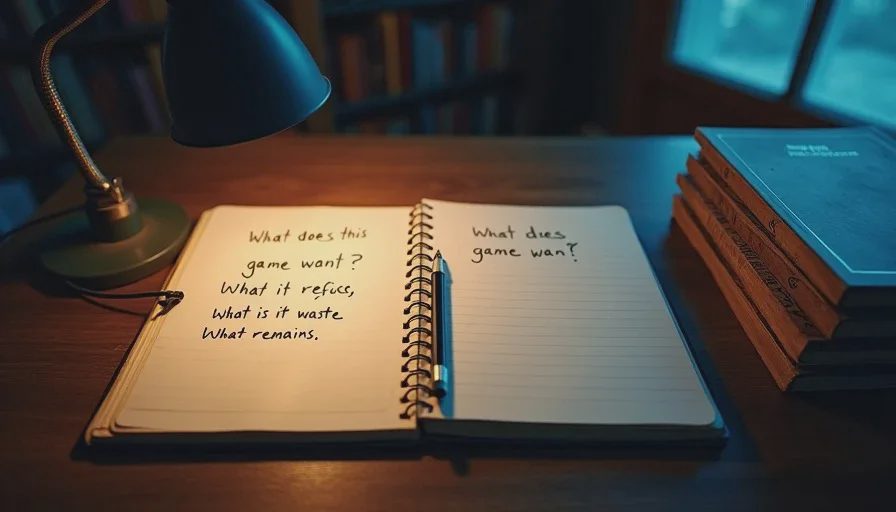
Four questions sit in my notebook, written years ago and never erased: What does this game want? What does it refuse? What does it waste? What remains? Together they turn a shapeless impression into a claim. A review that answers all four, even briefly, sounds certain because it has taken a position on both the game's intent and its execution — two different things that reviews routinely blur into one.
One line shows up in my editorial game reviews more than any other: Not every good game is worth your time. It reads like a dismissal until you sit with it. It is a standard, a way of granting a game its quality while still rendering a verdict on the player's hours, which is the actual job of a review. That distinction is where the sound of certainty comes from.
In practice, the difference between writing that sounds sure and writing that sounds shaky is almost visible on the page. Here is the short version of what I look for in a draft:
Reads as certain | Reads as hedged |
|---|---|
A specific claim: "The tutorial spends forty minutes before the world opens." | "The tutorial might feel a bit long for some players." |
A named trade-off: "It trades depth for speed, and the trade is worth it." | "It's a mixed bag, I guess." |
A stated standard: "Judged as a run-based roguelite..." | "It's decent for what it is." |
A verdict up front: "This is worth your time; here is why." | "Whether this is for you depends on how you like..." |
The Grammar of Conviction
How a sentence is built matters more than the words inside it. The sound of certainty in thoughtful game reviews is mostly grammar: conclusions first, specific examples second, and hedge words removed unless they earn their place. Nothing in this section requires courage. It requires editing.
Conclusion First, Always
The paragraph that opens a review should be the paragraph that could close it. The reader should be able to read the first three sentences and know whether to buy the game or move on. This sounds obvious and is almost never done. Most first drafts in editorial game reviews bury the verdict at the end because the writer is still deciding. The fix is not to think harder; it is to move the decision to the top and let the rest of the piece become the argument for it.
Specifics Beat Superlatives
In editorial game reviews I keep a short list of moves that I teach to every writer I edit. They are small, and together they are the difference between prose that wobbles and prose that reports. Thoughtful game reviews fail more often from hesitation than from wrongness, and these six checks catch most of the hesitation:
Replace one strong adjective with one concrete detail. "Brutal" is a claim; "the second boss kills you in three hits" is evidence.
Write the verdict in one sentence shorter than twenty words, then open the review with it.
Use present tense for the game and past tense for your play session. Readers feel the difference even when they cannot name it.
Cut "seems," "feels," "maybe," "a little," "somewhat" — then read the sentence again. If it now overstates, the overstatement was already yours; fix the evidence, not the word.
Name your standard before you judge. A roguelite should be reviewed as a roguelite, not as a narrative adventure that happens to restart.
If a sentence contains the phrase "for fans of," the argument has stopped. Say what the game does instead.
None of these are tricks. They are the same choices editors make across every beat — a games criticism blog is not exempt from basic editorial discipline — and they are why a well-edited review of a mediocre game can read with more certainty than a gushing first impression of a great one.
Doubt Is Part of the Job
Certainty is a property of the writing, not a property of the writer. The critics I trust most are the ones who admit, privately and sometimes in print, that their first draft was a swamp of doubt. What separates professional editorial game reviews from a forum post is that the doubt is processed — examined, answered, or discarded — before the reader ever meets it. The reader does not need your hesitation; the reader needs your reasoning — thoughtful game reviews earn their certainty in that gap.
What Editors Actually Cut
On deadline nights, the cuts are almost never the writer's boldest claims. They are the retreats: the sentences that apologize two paragraphs after a strong claim, the plot summaries that exist to avoid committing to a judgment, the qualifiers that survived because the writer was tired. A good edit finds those and asks one question: is this line protecting the reader, or protecting you? If the answer is the second, the line goes.
The Rules That Keep Reviews Honest
Certainty has a compliance side, and it matters more than it used to. The FTC Endorsement Guides treat a review copy as a material connection that must be disclosed, and the FTC's 2023 rule on fake consumer reviews — which took effect in October 2024 — allows civil penalties for fabricated endorsements and for suppressing honest negative feedback. That is not a footnote for lawyers. It is a reason that careful outlets log every code, every PR relationship, and every paid placement before a word is written. My newsletter is not a large operation, but every issue treats disclosure as core: new game reviews for adults cannot trade trust for speed.
When I ran a reviews desk, the process had three non-negotiable parts:
Log every review code with its source and date, whether it was paid or provided, before the playthrough starts.
Disclose material connections inside the piece or the newsletter — not in a footer that no one reads.
Keep editorial separate from advertising. A glowing review of a sponsor's game that was arranged in a sales call is a liability, not a windfall.
And one more warning from the desk. Launch-week pressure is not evidence. If a publisher is pushing for a verdict before you have finished the campaign, the embargo exists for their schedule, not for your accuracy. The same goes for scale: difficulty is not importance, a ten-hour linear game is not worth less than a hundred-hour open world, and a modest budget is not an excuse. Judging a game by how hard or how long it is confuses the frame with the picture.
This is why I still ask the four questions at the end of every playthrough, and why in editorial game reviews the pieces that sound most certain are the ones where I was least sure when I started writing. The confidence came from the editing. Not every good game is worth your time, but a clear-eyed review of one always is — and that certainty, at least, is earned.





No feedback yet — submit the first.