
I spent eleven years inside game media—six of them deciding which reviews actually said something and which were just release-week adjectives stitched together around a number. This blog is what I write after leaving that machinery. The goal is straightforward: thoughtful game reviews that respect your time without flattening criticism into a shopping list. Not every good game is worth your time. That distinction—between a game being good and a game being worth your hours—is the whole reason I started writing here instead of filing copy for someone else's release-week calendar.
Why I Stopped Trusting the Number at the Bottom
The score was never the problem. The problem was what the score replaced. When you attach a number to a review, you give readers permission to skip the reasoning, and you give writers permission to skip it too. I watched editors I respected trim a paragraph of structural analysis because "the score already says it's good." I watched a reviewer I liked delete a sentence about a game's strange, withholding tone because the publisher wanted the piece to land cleanly on a Friday. That's how judgment quietly dies in this field—not through bad writing, but through the slow agreement that the number is the conclusion and the words are just furniture around it.
What a Score Hides
Here's what I mean concretely. A review can tell you a game is polished, lengthy, and feature-rich, and still never tell you whether it has anything on its mind. The number at the end—whether it's a 9, an 8.5, or a four-star rating—collapses several genuinely different questions into one gesture, and that collapse is where the real judgment leaks out:
The score claims to answer | What it actually obscures |
|---|---|
Is it well-made? | Whether "well-made" is the same as "meaningful" |
Is it worth the money? | Whether your hours are the real cost, not your dollars |
Is it fun? | What kind of attention it demands, and for how long |
Should you buy it? | Whether you'll still think about it a month later |
Is it important? | Important to whom, and by what standard |
I'm not against scoring because I'm precious about criticism as an art. I'm against it because I spent years watching it function as a shortcut that editors, writers, and readers all agreed to pretend was a conclusion. The number lets everyone skip the part that matters.
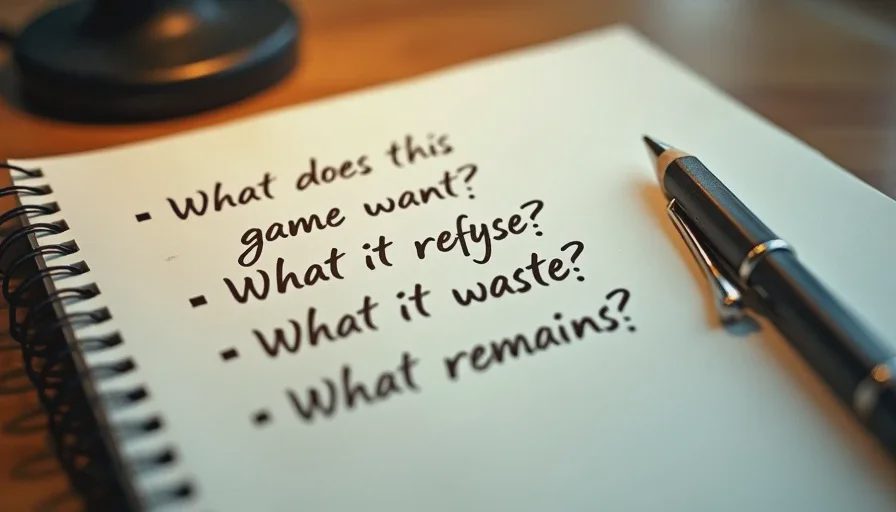
What I Write Instead, and How
I write thoughtful game reviews that lead with judgment and earn it. Every piece I publish here starts with four prompts I write by hand in a notebook before I touch a keyboard: What does this game want? What does it refuse? What does it waste? What remains? Those four questions keep me honest. I developed them during my reviews-editor years, when I needed a reliable way to tell whether a draft was actually saying something or just performing enthusiasm around a release date. They still work because they force me to engage with a game's intentions rather than its inventory.
The Structure I Hold To
A games criticism blog can drift into diary-keeping or consumer-reporting very fast, and I've seen good writers lose their footing in both directions. I try to avoid both by holding a consistent internal structure across every review I publish here:
Open with the judgment, not the hype. If I think a game is generous but hollow, I say that in the first paragraph, not the last.
Explain the structure, not just the features. Pacing, tone, and what a game refuses to do tell you more than a feature list ever will.
Separate craftsmanship from artistic force. A game can be meticulously built and still leave nothing behind. A game can be rough-edged and still stay with you for years. I name both honestly.
Quote the game's own language when it matters—system text, UI wording, a line of dialogue that reveals what the designers actually believe about the player.
Respect the reader's time in the writing itself. If a paragraph isn't pulling weight, I cut it before I publish, not after.
End on what remains. What sticks after the credits, not what impressed during the tutorial—the tutorial is always impressive; that's its job.

Who This Is For, and What It Costs You
This isn't a buyer's guide. If you want a yes/no purchase recommendation timed to release week, there are outlets that do that faster than I can, and some of them do it well. What I offer is slower, and I think more useful over time: a reader's judgment from someone who's spent a decade deciding what "saying something" actually means in game writing. I'm writing for adults who play games seriously and don't need to be told that a long game is automatically a valuable one, or that a high budget signals importance. I also try to write thoughtful game reviews that don't mock people for liking popular things—mainstream isn't a synonym for thoughtless, and I've read too many indie press pieces that confuse difficulty with depth.
I'm transparent about one limitation. I don't cover everything, and I never will. I write about what I've actually played long enough to form a judgment I'd stand behind, which means I skip plenty of major releases and most of the live-service churn. That's not neglect—it's the editorial standard I held at my old job, and I'm not lowering it now that the only editor is me. If a game isn't here, it usually means I haven't given it the hours it would take to say something real, or I decided the piece I'd write wouldn't add anything to the conversation already happening around it. Either way, the absence is deliberate.
If that pace sounds slow, it is. I'd rather publish one review a week that I believe in than five that I don't. The pace is the point—it's what lets judgment survive the moment when everyone else is rushing.





No feedback yet — submit the first.